

TPV is a dynamically vulcanized elastomer with EPDM rubber dispersed in a PP matrix.
It combines rubber elasticity with thermoplastic processability. It features excellent heat resistance, ozone resistance, weathering resistance and low compression set. It ages slowly outdoors and is fully recyclable. Typical applications are automotive seals, construction gaskets, waterproof strips and hoses requiring long-term durability.
TPV Thermoplastic Vulcanizate Manufacturer & Supplier
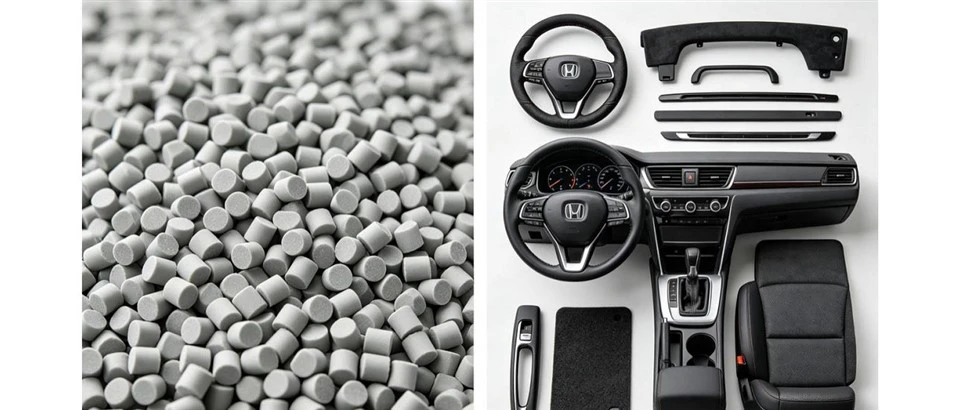
TPV Pellets for Automotive Interior and Exterior Parts
For selected interior and exterior components requiring flexibility, weather resistance or a soft-touch surface. Grade selection can consider odor, VOC, UV exposure, surface appearance and the intended molding process.
TPV for Seals and Gaskets
For sealing profiles, gaskets, weatherstrips and related components. Hardness, compression set, elastic recovery and long-term exposure conditions are key selection criteria.
TPV for Tubing and Extruded Profiles
For flexible tubes, protective profiles and other extruded parts. Material selection depends on flexibility, dimensional requirements, operating temperature and the extrusion process.
TPV for Wire and Cable Protection
For selected wire harness components, cable accessories and protective sheaths. Electrical, thermal, flame-retardant and environmental requirements should be confirmed for the intended application.
-
![TPV Pellets for Automotive Interior]() TPV Pellets for Automotive InteriorLow odor, low VOC, soft touch, scratch, stain and UV resistant.read more
1.Low odor and low VOC for better interior air quality
2.Soft touch and comfortable hand feeling
3.Scratch... -
![TPV Pellets for Rubber]() TPV Pellets for Rubber1.Combines rubber elasticity and plastic processabilityread more
2.Excellent weather and oil resistance
3.Resists high and low temperatures and aging
4.Halogen-free, non-toxic and... -
![TPV Pellets for Compounds]() TPV Pellets for Compounds1.Suitable for injection, extrusion and blow moldingread more
2.Hardness and performance can be customized
3.Excellent temperature, oil and weather resistance
4.Halogen-free, low-VOC and... -
![TPV Pellets for Communication Accessories]() TPV Pellets for Communication Accessories1.High electrical insulation performanceread more
2.Excellent weather and UV resistance
3.Effective waterproof and dustproof protection
4.Good flame retardant property
5.Stable... -
![TPV Pellets for Plastic]() TPV Pellets for Plastic1.Eco-friendly and fully recyclableread more
2.Excellent weather and wear resistance
3.High processability with good oil resistance -
![TPV Pellets for Electrical Appliance]() TPV Pellets for Electrical Appliance1.Non-toxic and odorlessread more
2.Temperature and aging resistant
3.RoHS compliant and safe -
![TPV Wire Harnesses]() TPV Wire Harnesses1.Excellent insulation and wear resistanceread more
2.Good oil resistance and flame retardancy
3.High flexibility for automotive and industrial use -
![TPV Pellets for Automotive Exterior]() TPV Pellets for Automotive Exterior1.Excellent weather and oil resistanceread more
2.High impact resistance
3.Stable performance in wide temperature range -
![TPV Pellets for Engine Peripheral Accessories]() TPV Pellets for Engine Peripheral Accessories1.High temperature and oil resistantread more
2.Excellent sealing performance
3.Effective shock absorption and noise reduction -
![TPV Pellets for Tubing]() TPV Pellets for TubingThis EPDM/PP dynamically vulcanized TPV pellet is designed for tube extrusion. It delivers excellent batch consistency for long-term mass procurement. With service temperature from -40℃ to 105℃,...read more


Typical Applications
Automotive Industry
Weatherseals & Glass Run Channels: Extruded dual-durometer co-extrusion profiles requiring long-term elastic recovery and UV resistance.
Under-the-Hood Components: Air intake ducts, steering gear boots, spark plug boots, and engine grommets exposed to elevated thermal cycles and motor oils.
Interior Trim: Soft-touch overmolded bezels, cup holder mats, and HVAC duct seals engineered for low fogging and low odor emissions (VDA 270 certified).
Building & Infrastructure
Window glazing gaskets, expansion joint seals, structural curtain wall profiles, and pipe connection seals resistant to ozone, acid rain, and compression fatigue.
Industrial & Appliances
Wire harness grommets, power tool strain reliefs, flexible couplings, washing machine drain hoses, and pump seals requiring high tear strength and electrical insulation.
Material Properties & Specifications
The following ranges are preliminary selection references, not guaranteed values for every TPV compound.
|
Property |
Test Method |
Unit |
Reference Range* |
|
Hardness |
ASTM D2240 |
Shore A / Shore D |
35A to 60D |
|
Density |
ASTM D792 |
g/cm³ |
0.95 to 0.97 |
|
Tensile Strength |
ASTM D412 |
MPa |
4 to 18 |
|
Tear Strength |
ASTM D624 |
N/mm |
15 to 100 |
|
Elongation at Break |
ASTM D412 |
% |
550 to 700 |
|
Low-Temperature Brittleness |
ASTM D746 |
°C |
Approximately -60 to -40 |
Custom Compounding & Material Development
Formulation adjustments resolve processing challenges and specialized operating conditions without requiring mold redesigns:
Compression Set Optimization:
Specialty curing pack chemistry lowers permanent deformation below 28% at 100°C for high-pressure sealing rings.
Die Swell & Melt Strength Control:
Tailored rheology for profile extrusion ensures tight dimensional tolerances on thin-wall bulb seal geometry.
Adhesion Promotion (Overmolding):
Specialized bonding grades achieve cohesive failure when co-extruded or overmolded onto PP, PE, and metal inserts.
Flame Retardancy & Chemical Resistance:
Halogen-free flame retardant (HFFR) grades achieving UL94 V-0 at 1.5mm while maintaining flexural fatigue life.
Processing & Quality Control
Processing Guidelines
TPV pellets absorb atmospheric moisture due to the hygroscopic nature of filler systems and additives. Pre-drying prevents splay, surface voids, and melt instability.
Drying:
Desiccant dryer recommended at 80 deg C to 90 deg C for 2 to 3 hours (target moisture content < 0.05%).
Injection Molding Temperatures:
Rear barrel 175 deg C to 185 deg C; Middle 185 deg C to 195 deg C; Front/Nozzle 195 deg C to 210 deg C. Mold temperature: 25 deg C to 50 deg C.
Extrusion Temperatures:
Barrel zones 170 deg C to 195 deg C; Adapter/Die head 195 deg C to 210 deg C. Screw compression ratio: 2.5:1 to 3.0:1.
Quality Control Standards
Batch consistency is verified on-site before shipment using calibrated testing protocols:
Melt Flow Index (ASTM D1238 / ISO 1133):
Ensures uniform cavity filling during multi-cavity injection runs.
Compression Set (ASTM D395 Method B / ISO 815):
Samples tested at extended thermal loads (100°C and 125°C)to ensure seal elasticity.
Hardness Uniformity (ASTM D2240 / ISO 868):
Shore A/D values held within $\pm 2$ units across production lots.
Tear Strength & Tensile Testing (ASTM D412 / ISO 37):
Verification of ultimate tensile strength and cross-machine direction tear resistance.
OEM Support & Bulk Supply
Sample Supply:
5kg to 25kg sampling lots shipped in sealed aluminum-barrier foil bags for tool trial runs.
Export Packaging:
Standard 25kg multi-wall paper bags with moisture-barrier PE liners; 500kg or 1000kg octabin gaylord boxes palletized and stretch-wrapped for sea freight container loading.
Production Lead Time:
Standard black/natural grades ship in 5 to 7 business days; custom formulations or custom color-matched lots require 10 to 14 business days.
Documentation Support:
Certificate of Analysis (COA) provided per batch. Third-party testing reports available for RoHS, REACH, and UL94 compliance.
FAQ

Request a Quote
Provide application parameters below to receive a technical data sheet (TDS), processing guide, or commercial pricing:
Processing method (Injection molding, Profile extrusion, Blow molding)
Target physical parameters (Hardness Shore A/D, Sealing temperature, Fluid exposure)
Color requirement (Black, Natural, Custom color)
Expected trial batch size and annual volume
Contact Kesun Polymer to discuss grade selection, sample evaluation and bulk supply.
Email: talia@kesuntpe.com
WhatsApp: +86 182 6102 3199
Kunshan Kesun Polymer Co., Ltd. is one of the most professional TPV manufacturers and suppliers in China, featured by quality products and low price. Please feel free to wholesale bulk eco-friendly TPV from our factory. Contact us for customized service and free sample.
TPV Engine Peripheral Accessories, TPV resin, TPV rubber granules